History
Before the Spanish conquest, weavers in Mexico worked mainly with cotton and other plant fibres, usually on the backstrap loom. In the sixteenth century the Spanish brought sheep and the treadle loom, and wool weaving on these looms spread during the colonial period. The sarape is often described as combining these introduced materials and tools with indigenous design traditions.
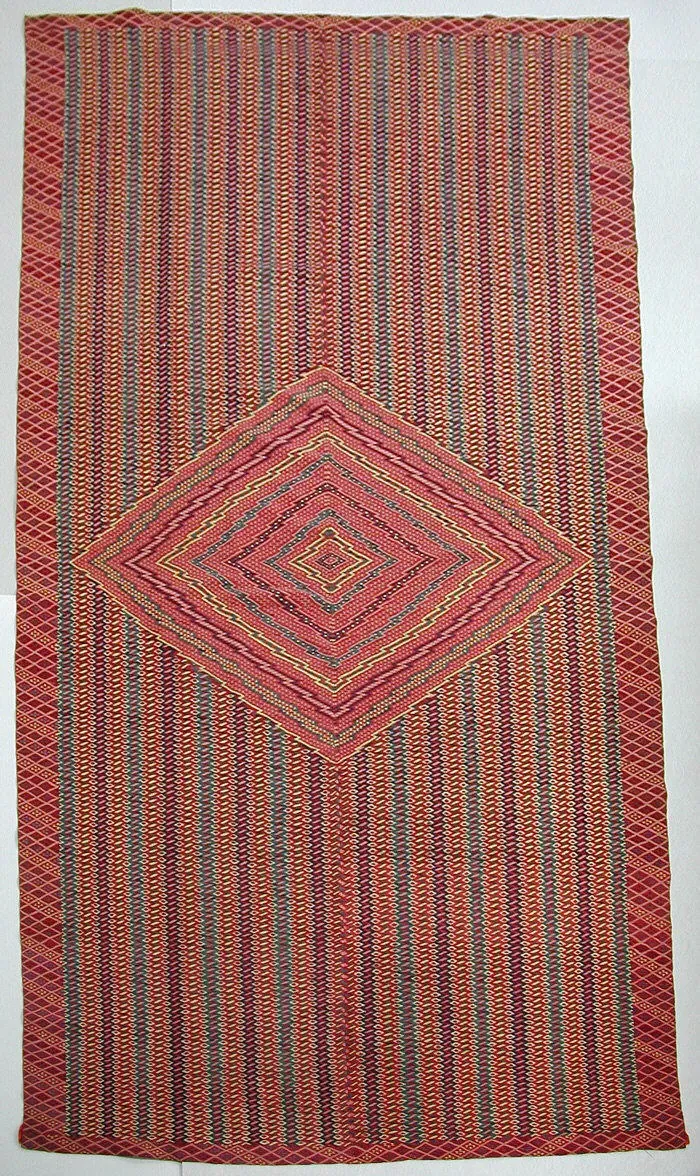
The best-known sarapes were made in and around Saltillo, in today’s state of Coahuila. Tlaxcalan settlers from central Mexico, who founded a community next to Saltillo at the end of the sixteenth century, are often credited with starting the local weaving tradition. Saltillo sarapes of the late eighteenth and early nineteenth centuries are finely woven in wool, sometimes on a cotton warp, with a large central diamond or medallion surrounded by tiny zigzag and stepped patterns. The example in the photo above dates from the first half of the nineteenth century.
Because the style was so admired, “Saltillo” came to describe a design as well as a place, and similar sarapes were woven elsewhere in Mexico. In the nineteenth century the sarape was part of the dress of horsemen, ranchers and travellers and became a symbol of Mexico. In the twentieth century, cheaper striped sarapes, often machine-made or of synthetic fibres, became common souvenirs.
Main styles
- Classic Saltillo sarape: a fine, tightly woven textile with a central diamond medallion and dense small-scale patterns, historically coloured with natural dyes.
- Striped sarape: bands of bright colours, often with fringes at the ends. This is the design most people picture today.
- Oaxaca weaving: in the Zapotec town of Teotitlán del Valle, weavers make wool sarapes and rugs on treadle looms, many with natural dyes such as cochineal red and indigo blue, and geometric designs.
- Sarape with a head opening: some sarapes have a slit in the centre so they can be worn over the head, much like a poncho.
How it is worn
A sarape is usually folded and worn over one shoulder, draped around the shoulders like a cape or wrapped around the body for warmth. Horsemen traditionally carried it over the shoulder or on the saddle and used it as a blanket at night. A sarape with a central slit is pulled over the head and falls over the chest and back.
The sarape has traditionally been a men’s garment, while the rebozo, a long, narrower shawl, is the classic women’s wrap in Mexico. As blankets and wraps, sarapes are now used by everyone.
Where you see it today
The sarape appears in some folklórico dance costumes, at national holidays and as part of charro-inspired outfits. It is also widely used as a blanket, bedspread, table runner or wall hanging, and Saltillo remains closely associated with it. Historic Saltillo sarapes are kept in museum collections in Mexico and abroad, including the one shown above.
Outside Mexico, the sarape is sometimes combined with a sombrero as a simplified “Mexican” costume, which many Mexicans see as a stereotype. To see the sarape alongside the huipil, rebozo, charro suit and china poblana, visit traditional clothing in Mexico.