Women’s traditional clothing
Looking for men’s traditional clothing? Jump directly to Men’s traditional clothing ↓.
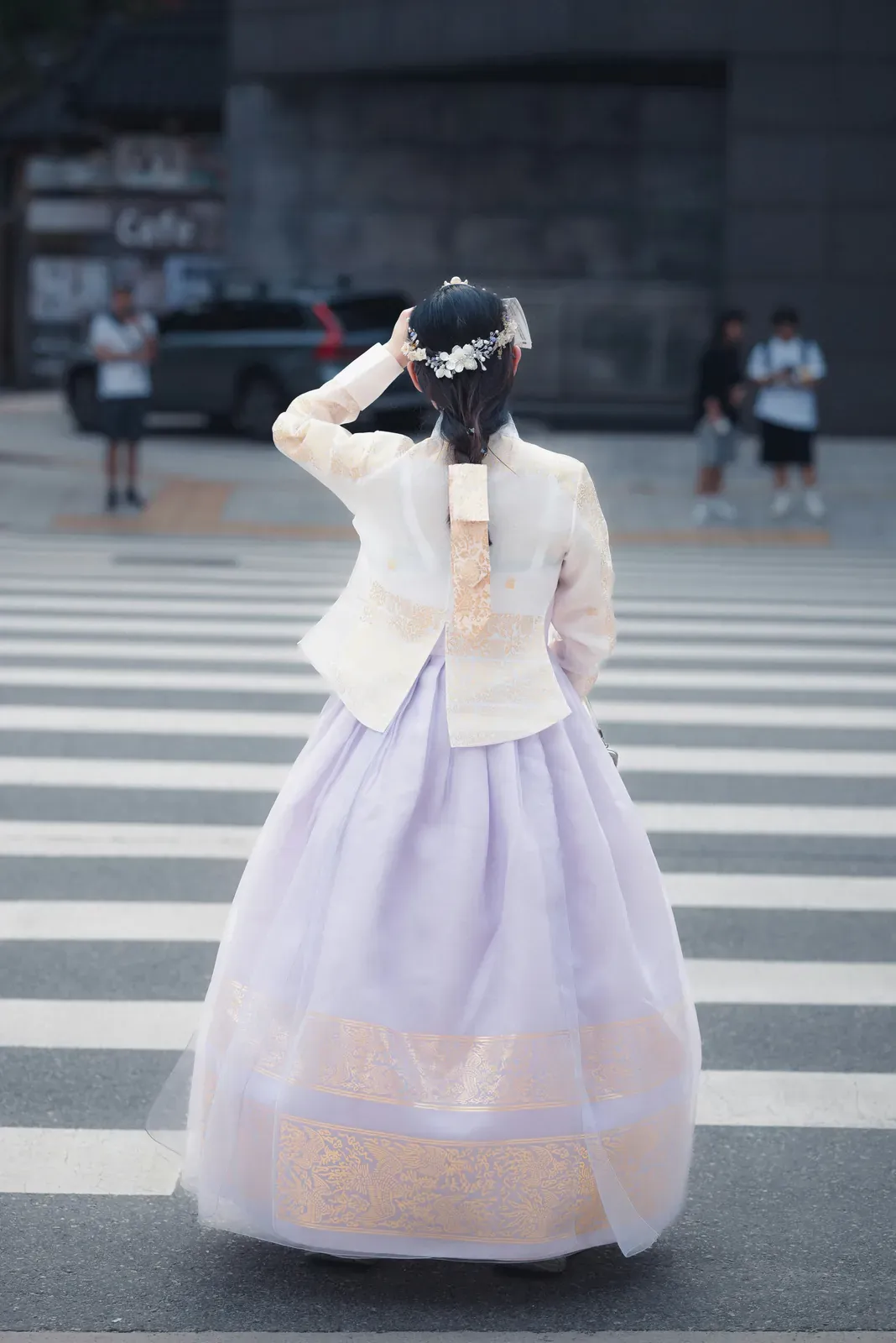
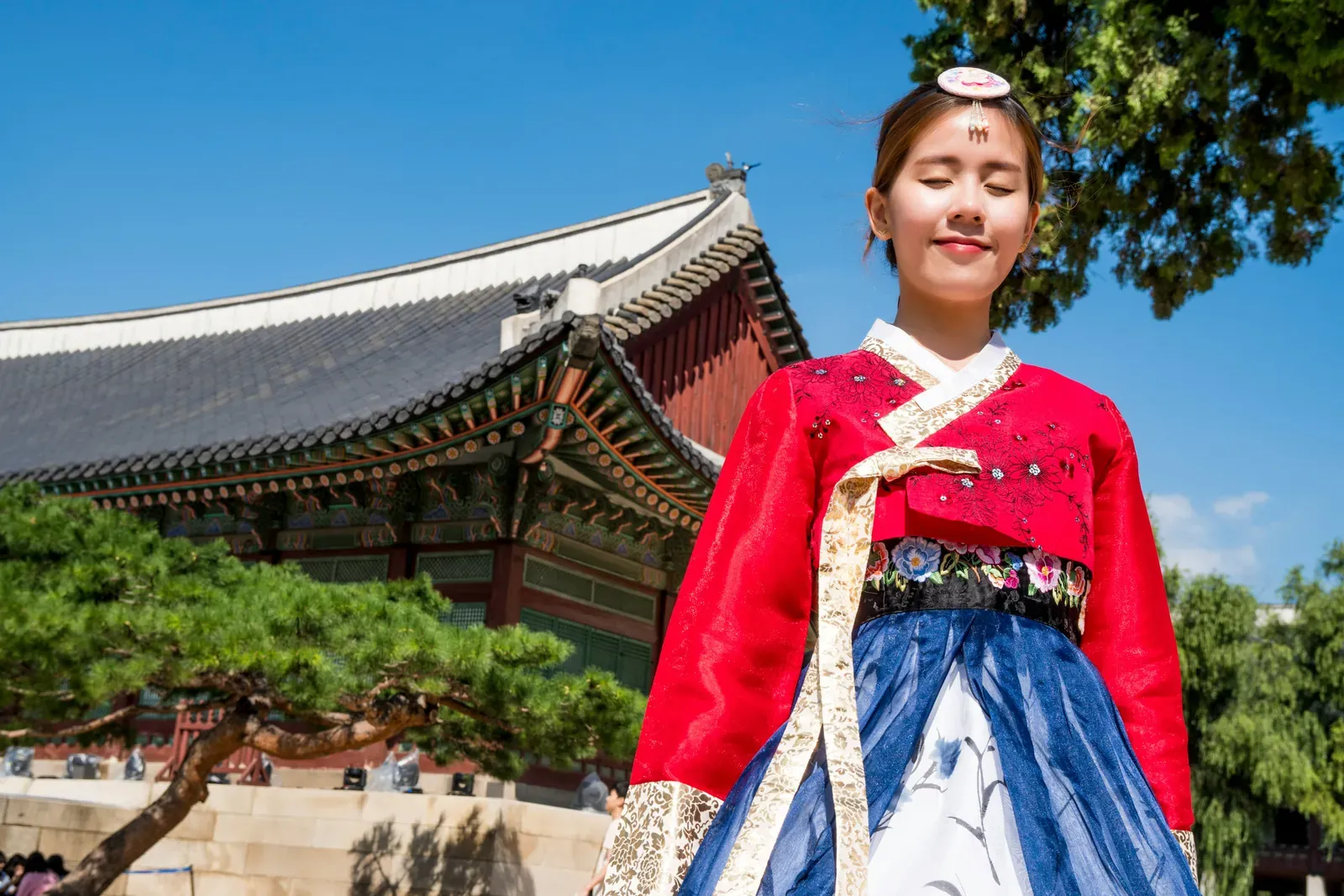
Traditional women’s clothing in South Korea centres on the graceful, bell-shaped silhouette of the women’s hanbok:
- Chima and Jeogori: the women’s ensemble consists of the jeogori, a cropped short jacket with curved sleeve lines and white collar trim (dongjeong), fastened across the chest with long decorative ribbons called goreum. It is paired with the chima, a voluminous, high-waisted wrap skirt that begins tightly pleated above the bust and sweeps outward to the floor, creating fluid movement. Read more on our hanbok page.
- Bridal and royal robes: for weddings and court occasions, women wore ceremonial outer gowns such as the hwarot (richly embroidered with peonies, phoenixes, and auspicious symbols) and the wonsam with colourful striped sleeves. These are crowned with the jokduri, a delicate jewelled black coronet.
- Accessories: women adorn their hanbok with the norigae, an intricate macramé silk pendant with hanging tassels, and secure their hair in a low chignon with the binyeo, an ornate silver, jade, or wooden hairpin.
Men’s traditional clothing
Looking for women’s traditional clothing? Jump to Women’s traditional clothing ↑.
Traditional men’s clothing in South Korea provides comfort, structural elegance, and dignified status:
- Baji and Jeogori: men’s hanbok comprises a hip-length jeogori jacket paired with baji, roomy trousers designed for easy sitting on floor cushions (ondol). The trousers are neatly gathered and tied at the ankles with fabric ribbons called daenim.
- Durumagi and Dopo: for formal outings and ceremonies, men wear full-length outer coats. The durumagi is an overcoat worn over the baji and jeogori, while the dopo is a wide-sleeved scholar’s robe featuring an additional rear flap, worn by Joseon yangban aristocrats.
- Gat and headwear: adult men wore the gat, an iconic wide-brimmed black cylindrical hat finely woven from horsehair and bamboo strips, worn over a topknot cap (sangtugan).
- Samo gwandae: the traditional wedding attire for grooms, replicating the uniform of high Joseon court officials with a round-collared blue or purple robe (danryeong), an embroidered rank badge (hyangbae), a stiff belt, and a winged official’s hat (samo).
Wedding attire
At a traditional Korean wedding (jeontong honrye), the bride wore a hwarot or a wonsam, ceremonial robes that were originally worn by women of the royal court. Brides of all classes were allowed to wear them on their wedding day. The hwarot is richly embroidered with flowers, birds and other motifs that stand for long life and happiness. The bride also wore a small crown (jokduri) or an ornate headdress, and red dots were painted on her cheeks and forehead. The groom wore the robe, belt and hat of a court official, known as samo gwandae.
Today most couples hold a Western-style ceremony, then change into hanbok for the pyebaek, a smaller ceremony that traditionally honoured the groom’s family and now often includes both families. The couple bow deeply to their parents, who toss jujubes and chestnuts that the couple try to catch in the bride’s skirt or a cloth, a wish for many children. The mothers of the couple often wear hanbok too, traditionally with the groom’s mother in cool shades such as blue and the bride’s mother in warm shades such as pink.
Festivals and celebrations
Hanbok is most often seen on the big family holidays and at milestones in a child’s life:
- Seollal, the Lunar New Year, usually falls in January or February. New clothes for the holiday are called seolbim, which traditionally meant a new hanbok, and many families still dress their children in one. Children perform a deep New Year’s bow (sebae) to their elders.
- Chuseok, the harvest festival on the 15th day of the eighth lunar month, brings families together for ancestral rites and shared meals. Some families wear hanbok for the day.
- A baby’s first birthday (dol) is a major celebration. The child usually wears a colourful hanbok, often with saekdong sleeves and a traditional cap, and takes part in doljabi: choosing one object from a table, which is playfully said to hint at their future.
Traditional clothing today
South Koreans wear Western clothes day to day. From around the 1990s, designers also began making modern hanbok, sometimes called saenghwal hanbok (“everyday hanbok”), with simpler cuts, shorter skirts and easy-care fabrics suited to daily life.
Hanbok has also become part of visiting historic places. Rental shops near Gyeongbokgung and other palaces in Seoul rent hanbok by the hour, and visitors wearing hanbok have been able to enter the royal palaces free of charge. Many rental outfits use bright colours, shiny fabrics or modern details that differ from historical dress.