Tracht: regional dress
The German word for traditional dress is Tracht (plural Trachten), related to the verb tragen, “to wear”. In the countryside, clothing used to show where a person came from, and in many areas also their religion, marital status and the occasion. From the nineteenth century onwards, factory-made clothing and urban fashion gradually replaced these regional styles in daily life.
Today Tracht is kept alive mainly by local costume associations (Trachtenvereine), families and festivals. Alongside the historical regional costumes there is Trachtenmode, a fashion industry that produces modern dirndl and lederhosen in many colours and cuts that are not tied to any particular region.
Women’s traditional clothing
Looking for men’s traditional clothing? Jump directly to Men’s traditional clothing ↓.
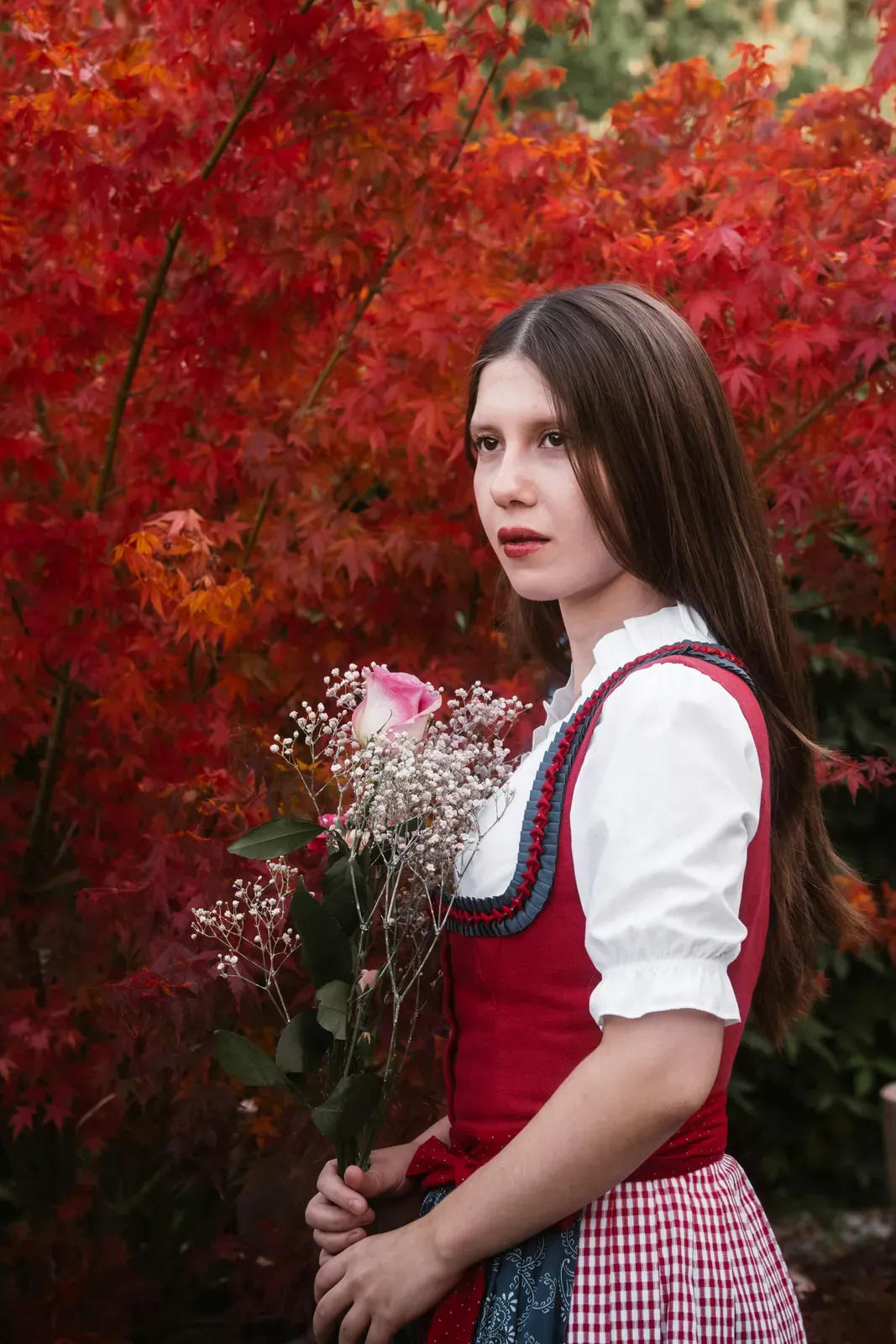
The best-known women’s traditional garment in Germany is the dirndl, which originated in Bavaria and the wider Alpine region. The dirndl consists of a fitted bodice (Mieder) with a low neckline, a wide gathered skirt, a white blouse worn underneath, and an apron tied at the waist. Traditionally, the placement of the apron’s bow indicates marital status: tied on the left indicates unmarried, on the right indicates married or committed, and at the back indicates a widow or waitress. Originally the work dress of Alpine farm women and domestic staff, the dirndl was adopted as fashionable summer wear by urban society in the late nineteenth century. Read more on our dirndl page.
Women’s traditional clothing outside the Alpine south shows remarkable regional variety:
- Black Forest: women of the Protestant communities of Gutach, Kirnbach, and Reichenbach wear the iconic Bollenhut, a broad straw hat adorned with fourteen woollen pompoms—red for unmarried women and black for married women.
- Hesse: the Schwalm region is famous for its women’s Tracht with multiple layered underskirts and small decorative caps (Betzel).
- North Frisia: on the island of Föhr, women wear a dark festive costume embellished with elaborate filigree silver breast jewellery (Filigranschmuck).
- Lusatia: Sorbian women maintain distinct historical Trachten with starched lace headdresses worn for church festivals and Easter.
Men’s traditional clothing
Looking for women’s traditional clothing? Jump to Women’s traditional clothing ↑.
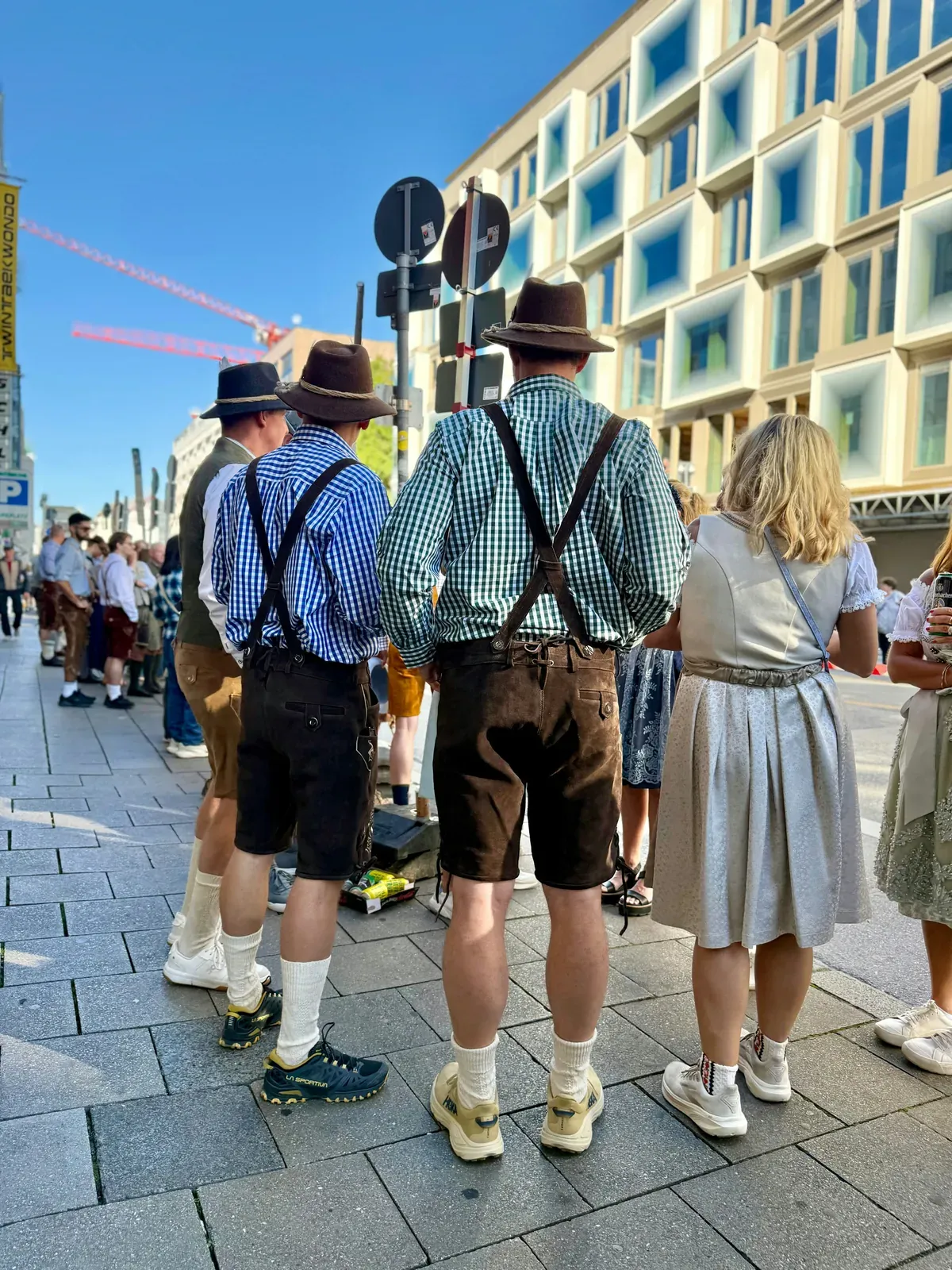
The pre-eminent men’s traditional attire in Germany is lederhosen, durable leather breeches crafted from tanned deer, goat, or cowhide. Lederhosen are cut either short (ending above the knee) or as Kniebundhosen (fastened below the knee), held up by H-shaped leather suspenders with an intricately embroidered cross-strap (Quersteg) across the chest. Engineered for durability, they were originally practical everyday workwear for farmers, foresters, and mountain hunters.
Today, lederhosen are celebrated festive attire worn with a checked or plain white linen shirt, a sleeveless waistcoat (Weste) or boiled wool jacket (Janker), two-piece calf warmers (Loferln) or woollen knee socks, and side-laced Haferlschuhe shoes. The look is frequently completed with a traditional felt hat adorned with a Gamsbart (a tuft of chamois hair). Across German-speaking regions, men also wear the Trachtenanzug, a tailored loden suit with stand-up collar and horn buttons suitable for formal gatherings.
Regional variety
Outside the Alpine south, Germany’s Trachten look very different:
- Black Forest: the Bollenhut, a white straw hat topped with large woollen pompoms, traditionally belongs to the costume of the Protestant communities of Gutach, Kirnbach and Reichenbach. Unmarried women wear it with red pompoms, married women with black ones. It has become a symbol of the whole Black Forest.
- Lusatia: the Sorbs, a Slavic minority in Saxony and Brandenburg, have several distinct costumes with elaborate starched headdresses. They are still worn at Easter, church festivals and weddings.
- Hesse: the Schwalm region is known for its colourful women’s costume with several layered skirts and small caps.
- North Frisia: on the island of Föhr, women wear a dark costume with rich silver jewellery for confirmations and other festive occasions.
Wedding attire
Most couples in Germany today marry in a white wedding dress and a suit. In Bavaria and Austria, however, many choose Tracht for the church or civil ceremony: the bride in a festive dirndl, often made of silk and sometimes in white or cream, and the groom in lederhosen or a Trachtenanzug, a traditional-style suit with a Janker jacket.
Before the white wedding dress spread in the late nineteenth and twentieth centuries, brides in many rural regions married in their best Tracht, which was often black. Some regions had special bridal headdresses, such as the Schäppel, a crown decorated with glass beads, from parts of the Black Forest.
Festivals and celebrations
- Oktoberfest in Munich, held since 1810, is where most visitors see dirndl and lederhosen. On the first Sunday, a large parade of costume and riflemen’s clubs (Trachten- und Schützenzug) shows costumes from Bavaria and many other regions.
- Other folk festivals (Volksfeste), such as the Cannstatter Wasen in Stuttgart, and many smaller village fairs have a similar dress culture.
- Church and village festivals, such as Kirchweih (the anniversary of a church’s consecration), maypole raisings and processions, are traditional occasions for Tracht in much of southern Germany.
Traditional clothing today
In Bavaria it is common to wear a dirndl or lederhosen to folk festivals, weddings and some family celebrations, and some people wear Tracht to church or at work in traditional inns. In recent decades Tracht has become popular again with young people, especially for Oktoberfest, although many outfits worn there are fashion designs rather than historical regional costumes.
In other parts of Germany, traditional dress is worn mainly by costume associations, at local heritage festivals and in parades. Dirndl and lederhosen are therefore best understood as Bavarian and Alpine clothing rather than as the dress of all of Germany.