Many peoples, many styles
Nigeria has hundreds of ethnic groups and languages, so there is no single “Nigerian” costume. The Hausa and Fulani are the largest groups in the north, the Yoruba in the south-west and the Igbo in the south-east. Many other peoples, such as the Edo, Ijaw, Efik, Tiv and Kanuri, have their own dress traditions. Religion, rank and occasion shape what people wear as much as ethnicity does.
Women’s traditional clothing
Looking for men’s traditional clothing? Jump directly to Men’s traditional clothing ↓.
Traditional women’s clothing in Nigeria is celebrated for its sculptural elegance, vivid colours, and rich fabrics across different ethnic traditions:
- Iro and buba: the foundational Yoruba women’s attire, featuring a wraparound skirt (iro) tied at the waist and a loose-fitting blouse (buba). For special occasions, it is crowned by the gele, an ornate head tie folded from stiff metallic or cotton fabric into dramatic architectural shapes, and the ipele, a matching sash draped gracefully over the shoulder.
- George wrappers and coral beads: in Igbo and Niger Delta communities, women wear double layered wrappers made of George, a dense, richly embroidered fabric with scalloped edges. This is paired with an embroidered lace blouse, an artfully tied headwrap, and cascading strings of genuine polished coral beads (aka or ivie) around the neck and wrists, symbolising dignity, royalty, and noble lineage.
- Northern wrappers and veils: Hausa and Fulani women in northern Nigeria commonly wear matching wrappers and fitted blouses, accompanied by a headscarf (kallabi) and a flowing draped veil or shawl (mayafi) covering the head and shoulders in accordance with local and religious traditions.
- Aso Oke and Adire: women frequently wear garments made from aso oke (“prestige cloth”), handwoven on narrow looms into strips sewn together, or adire, indigo resist-dyed cotton originating from Abeokuta.
Men’s traditional clothing
Looking for women’s traditional clothing? Jump to Women’s traditional clothing ↑.
Nigerian men’s traditional dress is commanding and distinguished:
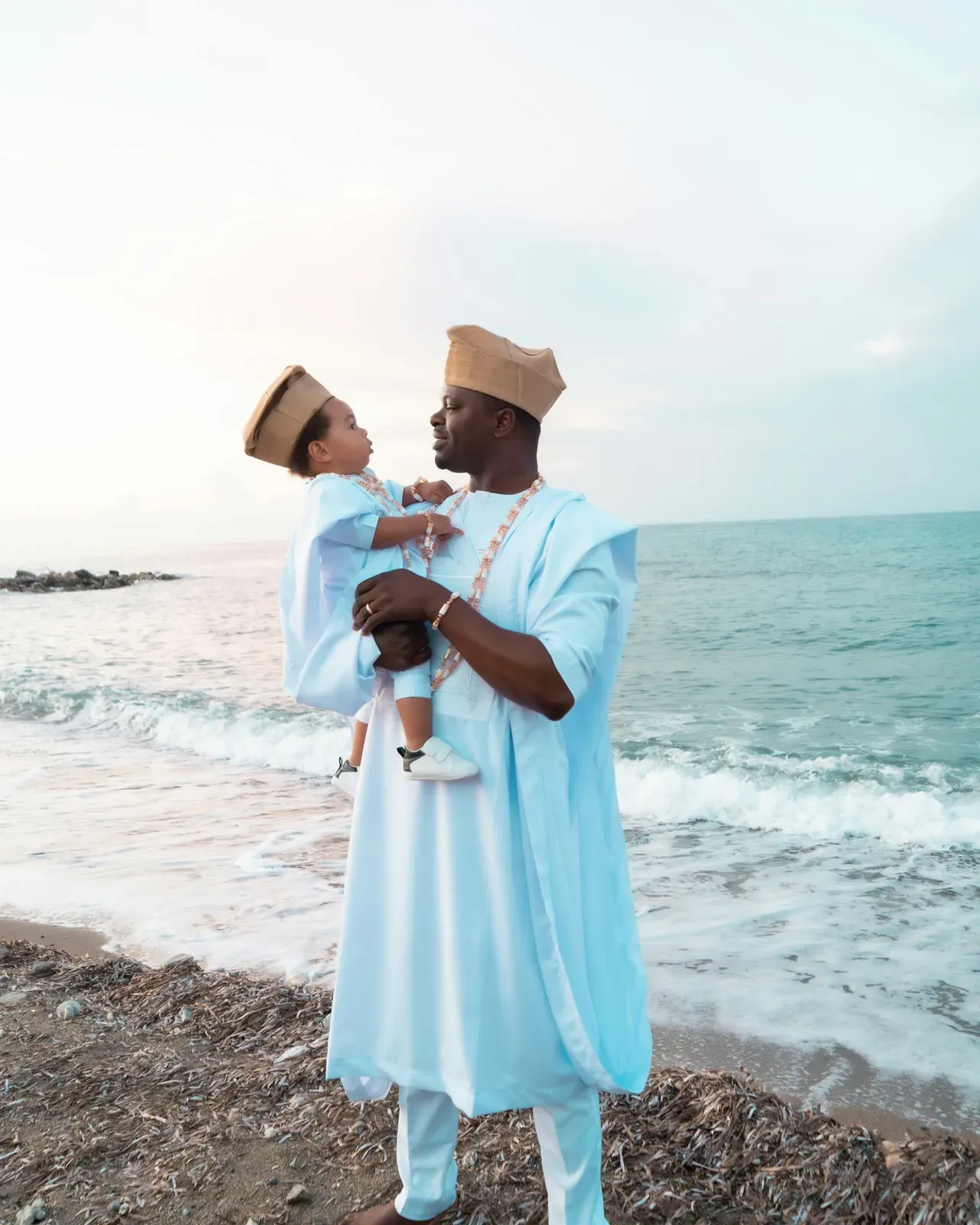
- Agbada: the majestic, wide-flowing four-piece robe worn by Yoruba men and widely embraced across West Africa. It comprises a voluminous, ankle-length outer gown with wide sleeve folds that drape over the shoulders, an inner tunic (buba), tailored drawstring trousers (sokoto), and an embroidered fabric cap (fila). Read more on our agbada page.
- Babban riga: the grand gown worn by Hausa and Fulani men in the north, featuring dense, geometric embroidery around the neckline and chest pocket. It is worn over a long tunic and trousers, topped with an embroidered hula cap or a ceremonial turban.
- Isiagu: the celebrated pullover tunic of Igbo men, patterned with iconic lion head motifs (isi agu means “lion’s head”). It is worn over tailored trousers or a wrapped cloth, paired with a walking stick and the traditional red cap (okpu agu), a mark of titled elders and chiefs.
- Kaftans and senator suits: tailored long-line tunics and trousers crafted from crisp cotton or wool, widely worn for everyday business and semi-formal social events.
Wedding attire
Many couples hold a traditional wedding as well as, or combined with, a church, mosque or civil ceremony. Customs vary by group:
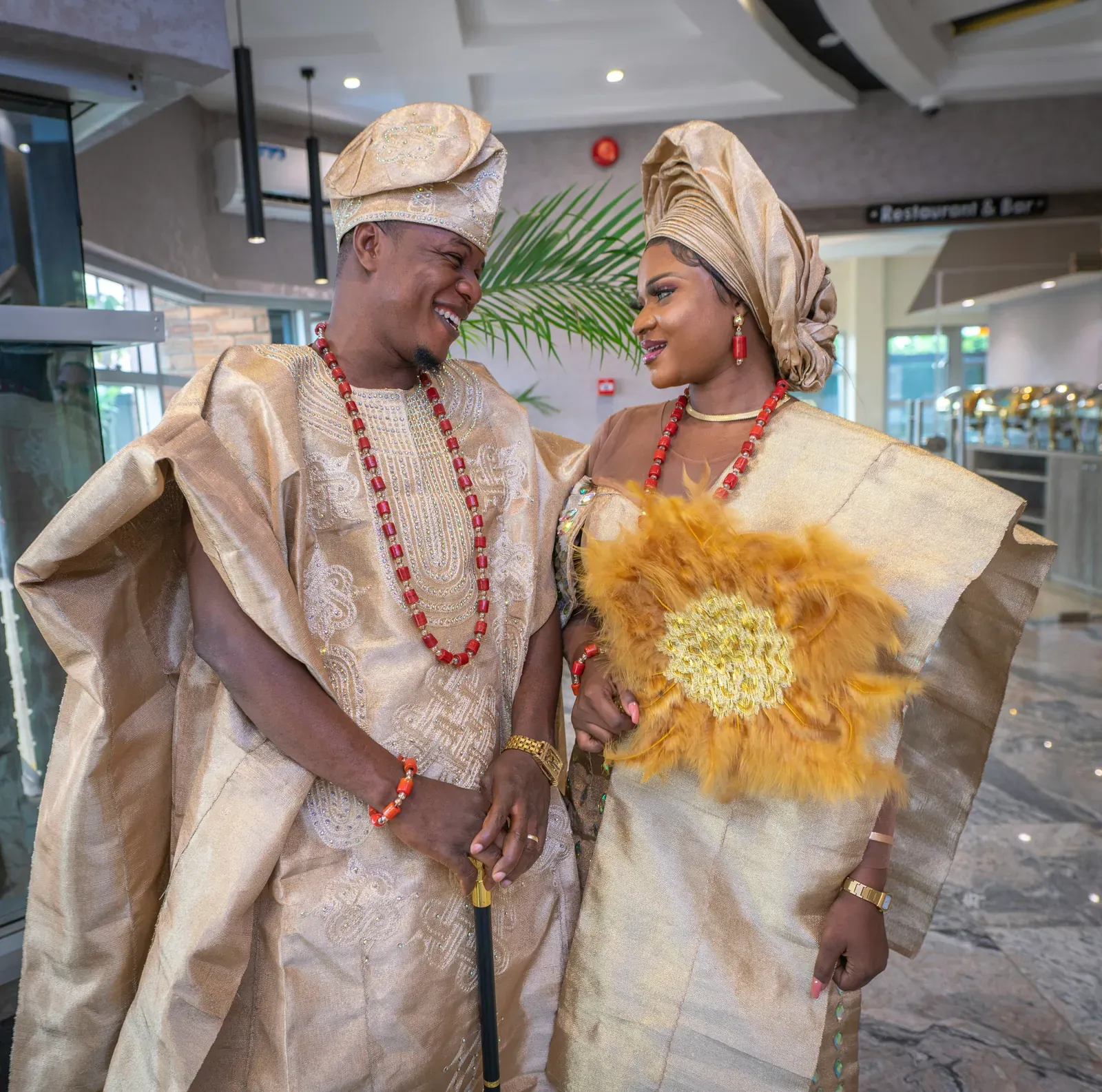
- At a Yoruba traditional wedding, the couple often wear matching aso oke: the bride with a large gele, the groom in an agbada and fila.
- At an Igbo traditional wedding (igba nkwu, “wine carrying”), the bride traditionally looks for the groom among the guests and offers him a cup of palm wine. Igbo and Edo brides often wear coral bead necklaces and headpieces.
- At Hausa weddings, henna designs on the bride’s hands and feet are common.
Couples often coordinate their colours, as in the photo above, and family and friends frequently wear aso ebi.
Aso ebi and celebrations
Aso ebi (Yoruba for “family cloth”) is the custom of guests wearing outfits made from the same fabric, chosen by the family hosting an event. It is associated with the Yoruba and is now common at weddings, funerals and birthdays across much of Nigeria. Guests usually buy the fabric and have it sewn in their own style.
Other occasions for traditional dress include:
- Durbar festivals in northern cities such as Kano, Katsina and Zaria, held around the Eid celebrations, where horsemen parade in elaborate robes and turbans.
- Eid and Christmas, when many people wear new or formal outfits.
- New Yam festivals in Igbo communities, where traditional attire is common.
Traditional clothing today
Traditional dress is widely worn in Nigeria, not only for ceremonies but also to religious services, work and public events. Tailors and designers work with aso oke, lace, George and Ankara, a colourful wax-print fabric used for both traditional styles and modern clothes. Many people choose a fabric and have it made to measure.